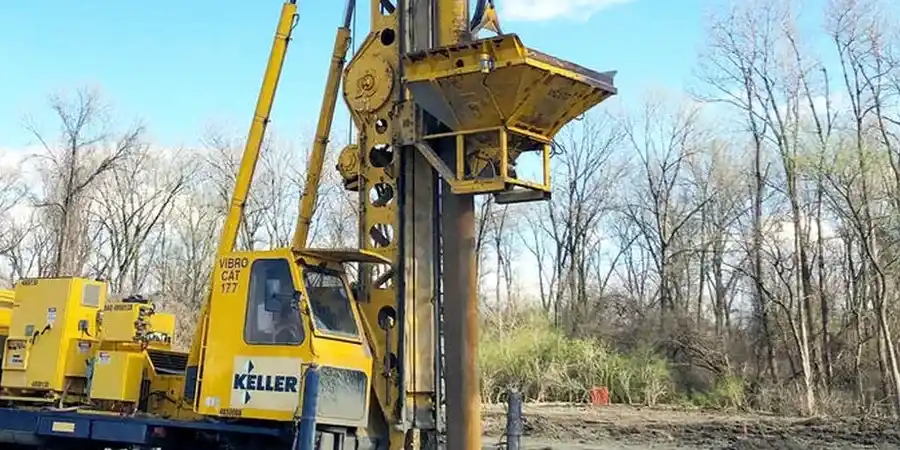
Albuquerque sits at roughly 5,300 feet above sea level, but the real elevation challenge here is underground: the Rio Grande rift filled centuries of alluvial deposits with loose, poorly graded sands that shift under load. In our experience, standard compaction methods rarely reach the depths needed for commercial pads or bridge approaches in the North Valley or near the Bosque. That is where vibrocompaction design becomes a practical necessity. We develop site-specific layouts that account for the city's variable groundwater—often encountered between 8 and 20 feet—and the silty interbeds that can drain energy away from the vibrator. A proper design sequence starts with penetration resistance data, which we correlate using SPT drilling to map target horizons before laying out the triangular grid. The goal is always the same: a uniform relative density above 70% that eliminates differential settlement risk under the kind of thermal and seismic cycles Albuquerque buildings face year after year.
In Albuquerque's Rio Grande basin deposits, a 5-foot grid spacing with a 150 kW vibrator typically achieves 75% relative density within three passes—when the fines content stays below 12%.
Process and scope
Area-specific notes
Albuquerque's West Mesa and the floodplain east of the river present very different risk profiles for a vibrocompaction program. On the Mesa, cemented caliche layers can block the vibrator tip, requiring pre-drilling that complicates the production rate and budget. Along the floodplain, the shallow water table—often just 6 feet down near the Paseo del Norte corridor—forces the use of a bottom-feed system, and if the design does not specify the correct stone gradation, the contractor ends up pumping fines into the treatment zone instead of draining them. The bigger consequence is post-construction settlement under the city's intense diurnal temperature swings: a poorly densified zone beneath a slab-on-grade will open hairline cracks within the first two winters. Our design reports quantify that risk by coupling the target relative density with settlement estimates under the IBC allowable bearing pressures, so the owner in Albuquerque knows exactly what performance level the treated ground will deliver.
Relevant standards
ASTM D1586-18 (Standard Test Method for Standard Penetration Test), ASTM D6913/D6913M-17 (Particle-Size Distribution by Sieving), FHWA-NHI-16-072 (Ground Improvement Methods, Vol. I)
Linked services
Feasibility and grid design
We analyze existing SPT or CPT logs from your Albuquerque site, classify the soil profile, and determine whether vibrocompaction is suitable. When it is, we deliver a stamped design package with probe spacing, depth, vibrator specifications, and a point-by-point quality control plan tied to the city's building permit submittal requirements.
Construction-phase verification
During treatment we oversee in-situ testing—SPT or CPT—at grid intersections to confirm the specified relative density is achieved. We compare pre- and post-treatment blow counts, adjust withdrawal rates if needed, and issue a final compaction report accepted by Albuquerque's development review engineers.
Typical parameters
Common questions
What subsurface conditions in Albuquerque make vibrocompaction a good choice?
Vibrocompaction works best in the loose, clean to slightly silty sands found across much of the Rio Grande floodplain and the Santa Fe Group deposits underlying Albuquerque. The key is fines content: if the material passing the No. 200 sieve stays below 15% and the clay fraction is negligible, the vibrator can densify efficiently. Our feasibility assessment includes a sieve analysis and Atterberg limits to confirm the profile falls within that window before we commit to a full design.
How deep can vibrocompaction reach in Albuquerque's alluvial soils?
In the basin-fill deposits typical of Albuquerque, we routinely design treatment to depths between 65 and 80 feet. The practical limit depends on the vibrator horsepower, the presence of cemented caliche stringers that may require pre-drilling, and the groundwater level. With a 180 kW hydraulic vibrator and a bottom-feed system, we have successfully treated loose sands to 80 feet beneath the water table on projects near the river.
What does a vibrocompaction design package cost for an Albuquerque project?
For a typical commercial lot in Albuquerque, the design package—including feasibility review, grid layout, method statement, and construction-phase verification protocol—runs between US$1,660 and US$4,920. The spread depends on the treated footprint, the number of exploration points we need to analyze, and whether pre-drilling design is required. We provide a fixed-fee proposal after reviewing your geotechnical exploration data.
How do you verify that the compaction met the design target?
We specify a post-treatment testing grid—usually SPT or CPT borings at every intersection of the probe grid, covering at least one test per 1,000 square feet. Pre- and post-treatment blow counts or tip resistances are compared directly, and we calculate the achieved relative density. The results are compiled in a stamped verification report that becomes part of the building permit record for your Albuquerque project.